Friday, 4 November 2011

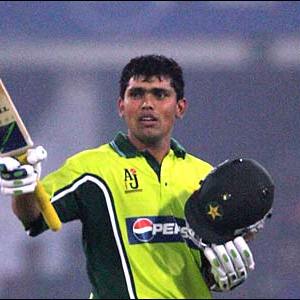
Kamran Akmal

Kamran Akmal Biography

Full name Kamran Akmal

Born January 13, 1982, Lahore, Punjab

Current age 29 years 6 days

Batting style Right-hand bat

Fielding position Wicketkeeper

Relation Brother - Adnan Akmal, Brother - Umar Akmal

Major teams Pakistan, Asia XI, Lahore, Lahore Blues, Lahore City, Lahore Eagles, Lahore Lions, National Bank of Pakistan, Punjab Stallions, Rajasthan Royals


Kamran Akmal 
Kamran Akmal 
Kamran Akmal 
Kamran Akmal 

Kamran Akmal 

Kamran Akmal 

Kamran Akmal 

Kamran Akmal 

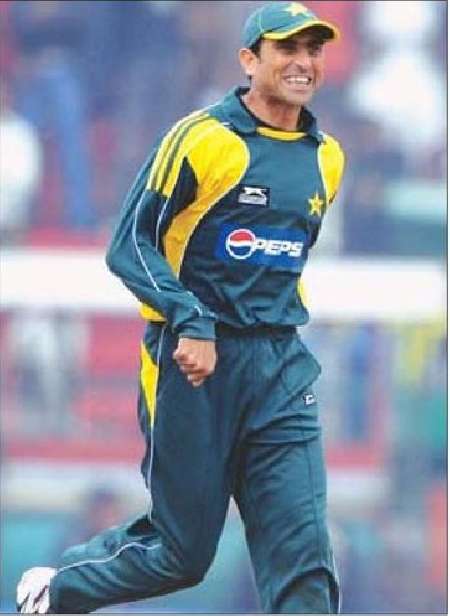
Younis Khan

Younis Khan Biography

Full name Mohammad Younis Khan

Born November 29, 1977, Mardan, North-West Frontier Province

Major teams Pakistan, Habib Bank Limited, Nottinghamshire, Peshawar Cricket Association, Rajasthan Royals, South Australia, Surrey, Warwickshire, Yorkshire

Also known as Younus Khan

Playing role Middle-order batsman

Batting style Right-hand bat

Bowling style Right-arm medium, Legbreak

Younis Khan is fearless, as befits his Pathan ancestry and will forever be remembered as the second Khan to bring home a world title for Pakistan: Younis was Pakistan's captain in the 2009 World Twenty20, leading a successful campaign with stark similarities to the one Imran Khan had led 17 years earlier. Younis retired from the format straight after, a graceful and dignified gesture from a complex but honest man.


It is as a batsman, and a fearless one, that he made his name first, playing with a flourish. He is especially strong in the arc from backward point to extra cover. He is prone to getting down on one knee and driving extravagantly. But this flamboyance is coupled with grit.


Though Younis was one of the few batsmen who retained his place in the team after Pakistan's disastrous World Cup campaign in 2003, he lost it soon after due to a string of poor scores in the home series against Bangladesh and South Africa. He came back for the one-day series against India, but failed to cement a place in the Test side. He is among the better fielders in Pakistan and he took a world-record four catches in one innings as substitute during Pakistan's demolition of Bangladesh in the 2001-02 Asian Test Championship.


But until his return to the side in October 2004, he wasn't a fixture. At the pivotal one-down, against Sri Lanka in Karachi, a century laid the groundwork for his emergence as a force in Pakistan cricket. He was the top run-getter in the disastrous 3-0 whitewash in Australia immediately after and on the tour of India, for which Younis was elevated to vice-captain, he blossomed. After a horror start to the series he came back strongly, capping things off with a match-winning 267 in the final Test. He credits the late Bob Woolmer, to whom he was close, for the turnaround in his career.


Since then, barring minor troughs such as the 2005-06 series against England at home, his career has been one elongated peak, scoring hundreds against India and England for fun and becoming Pakistan's most successful one-down in recent memory. More importantly, the tour to India also showcased his potential as a future captain of Pakistan and his energetic and astute leadership has impressed many people. As captain in Inzamam's absence he led the side to a disastrous loss against the West Indies in 2005 but also to a memorable win against India in Karachi in January 2006.


He blotted his book by suddenly resigning from the captaincy in Inzamam's absence for the Champions Trophy 2006, only to return a day later and lead a scandal-afflicted side to a disappointing first round exit. He was the favourite to take over the captaincy after Pakistan's ignominous World Cup ouster in 2007 but he turned it down, citing mental strain and decided to honour his commitment with Yorkshire by making himself unavailable for Pakistan. In January 2009, however, the PCB came calling a third time, after Pakistan's disastrous home ODI series against Sri Lanka, and appointed him captain in place of Shoaib Malik. Within a few months, with the Twenty20 win, Younis was looking a natural leader.


But the peace, once again, did not last long and several senior players in the team expressed misgivings over Younis' leadership. Things came to a head against New Zealand in Sharjah, after which he announced his resignation from the top-job and sought a break from the team for the tour down under. He was included in the ODI team, midway through a disastrous tour, but struggled for form and runs. His career hit its biggest controversy in March 2010 when, along with Mohammad Yousuf, he was banned by the PCB from all Pakistan teams, for causing infighting within the team, in effect ending his career.

Younis Khan
Younis Khan
Younis Khan
Younis Khan
Younis Khan
Younis Khan
Younis Khan
Younis Khan


Younis Khan 78 Runs off 72 balls Pakistan VS Zimbabwe 1st ODI

Captain's Corner: T20 WorldCup Final (21st June 2009)

Asad Shafiq

Asad Shafiq Biography

Full name Asad Shafiq

Born January 28, 1986, Karachi, Sind

Major teams Pakistan, Karachi Blues, Karachi Dolphins, Karachi Whites, Karachi Whites, Karachi Zebras, North West Frontier Province, North West Frontier Province Panthers, Pakistan A, Pakistan Cricket Academy, Sind, Sind Dolphins

Playing role Middle-order batsman

Batting style Right-hand bat

Bowling style Legbreak

Fielding position Wicketkeeper

A right-hand top order batsman, Asad Shafiq is a product of the Karachi tape ball circuit. He stormed the first-class scene in his debut season in 2007-08, scoring a double-hundred. He fell short of thousand runs that season, but attained the milestone two seasons later, when he scored 1244 runs in 12 games at 49.76. He made an impact as a limited-overs player in 2008-09, when he scored 379 runs in seven games at 54.14. The national selectors had earmarked him as one for the future in meetings and he was rewarded him with a call-up for the Asia Cup in 2010.

Asad Shafiq
Asad Shafiq
Asad Shafiq
Asad Shafiq
Asad Shafiq
Asad Shafiq
Asad Shafiq
Asad Shafiq

Asad Shafiq - Mr Solid


Pakistan vs Zimbabwe Asad Shafiq Shots World Cup 2011

Tuesday, 1 November 2011

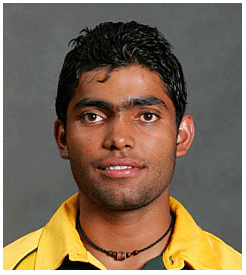
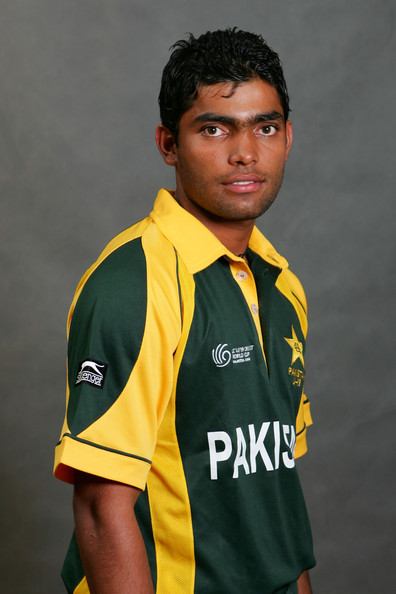
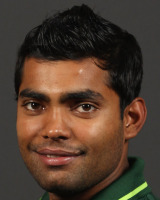
Umer Akmal

As explosive starts to one’s International careers go, few can rival Umar Akmal. He announced his entry with scores of 66 and 102* within his first 3 ODI innings (at Sri Lanka, 2009) in addition to a 129 and 75 on Test debut (at New Zealand, 2009). Those performances weren’t a surprise. At first class level, Akmal was renowned for his big scores amassed in quick time. 7 years prior to his debut, Umar’s elder brother Kamran had already gotten his taste of international cricket. By 2010, the siblings featured regularly, in tandem for Pakistan.
As a fearless, middle-order batsman, throughout Pakistan’s disappointing spree of series losses against Sri Lanka in 2009 and later at Australia in early 2010, Umar Akmal’s ascendance was one of their few positives. But as the series in Australia progressed, complacency began to creep into Akmal’s Test form, which started to dip. In ODIs though, a hundred and five fifties by his 18th outing maintained a steady average. It was enough to justify an inclusion in Pakistan’s 2010 T20 World Cup squad. He finished the tournament as Pakistan’s 3rd highest-run getter towards their semi-final run.
While still protected as a batsman, featuring at 3-down, in a Pakistan side that lacks specialist batsmen with the temperament for all forms of the game, Umar Akmal is their most proven rookie to fill the void for the years to come.

Fast Facts

  • Akmal’s total of 204 runs on his Test debut (against New Zealand) is the 8th highest ever.
  • It’s also the second highest for a Pakistani debutant behind Yasir Hameed’s 275 in 2003.
  • Akmal’s 129 on Test debut is the 4th highest for a Pakistani, making him one of only 7 players from his country to score a century on debut. Among those on the list, Akmal is the only centurion to have achieved the feat on foreign soil.
  • It took Umar Akmal 38 matches (6 Tests, 18 ODIs and 14 T20s) until playing for Pakistan in Pakistan, the third most behind teammate Mohammad Aamer (41) and Sri Lankan Greame Labrooy (53).
  • Along with brother Kamran Akmal, the Akmals are the 4th blood brothers to feature for Pakistan in the 60-odd years of cricket history.
  • Among top order batsmen, Akmal has the 4th best strike rate overall (Test, ODI and T20) for Pakistani players. (Minimum of 40 matches).


Umer Akmal

Umer Akmal

Umer Akmal

Umer Akmal

Umer Akmal

Umer Akmal

Umer Akmal

Umer Akmal


Umar Akmal's Maiden ODI Century Celebration

debut century umar akmal, great

Monday, 31 October 2011

Saeed Ajmal

Saeed Ajmal Biography
Born October 14, 1977, Faisalabad, Punjab

Major teams Pakistan, Faisalabad, Islamabad Cricket Association, Khan Research Labs, Water and Power Development Authority

Playing role Bowler

Batting style Right-hand bat

Bowling style Right-arm offbreak

Saeed Ajmal, an offspinner, received a call-up to the Pakistan squad for the Asia Cup at the age of 30 after an impressive domestic season with Khan Research Labs in 2007-08, during which he took 38 wickets in 12 first-class matches at an average of 29 apiece, and 12 wickets in nine list A games. He made an immediate impression with his subtle variations, unafraid to use the doosra. But his career took off with a series of ODI performances that bewildered Australia in Dubai and Abu Dhabi; he gave away few runs and his doosra was nigh-on unreadable. The ICC called him for his action, though it was cleared soon after. The pressure didn't get to him and immediately after, he played a crucial role in Pakistan's drive to the 2009 World Twenty20 title, regularly bottling up the middle overs with Shahid Afridi. He ended the joint second-highest wicket-taker in the tournament, with an exemplary economy rate as batsmen around the world struggled to pick a big turning doosra or even cope with his changes in flight, pace and angle. Consistent performances in the ODI version have quickly earned him a reputation for choking the runs in the middle overs with clever variations.

Saeed Ajmal
Saeed Ajmal
Saeed Ajmal
Saeed Ajmal
Saeed Ajmal
Saeed Ajmal
Saeed Ajmal
Saeed Ajmal

Saeed Ajmal Wickets


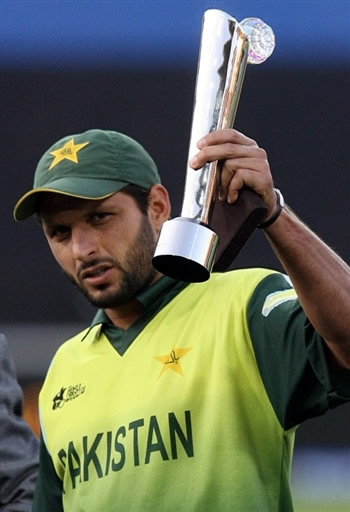
Shahid Afridi

Shahid Afridi Biography
Sahibzada Mohammad Shahid Khan Afridi (born 1 March 1980 in Khyber Agency), popularly known as Shahid Afridi, is a Pakistani cricketer currently playing for the Pakistani national team in the international circuit. He made his ODI debut on 2 October 1996 against Kenya in Nairobi[1] and his Test debut on 22 October 1998 against Australia at Karachi.[2] He is known for his aggressive batting style, and currently holds the highest career strike rate in the history of international cricket. In a recent survey, Afridi was named as the most popular cricketer in Pakistan.[3] He also holds the record for the fastest one day century which he made in his debut innings, as well as scoring 32 runs in a single over, the second highest scoring over ever in an ODI.

Style

His general style of batting is very aggressive and attack oriented and has earned him the nickname “Boom Boom Afridi” for his fastest One Day International century just in 37 balls. As of 22 May 2007, he has an ODI strike rate of 109.38 runs per 100 balls, the highest in the game’s history. This attitude has been transferred to Test cricket as well, with Afridi scoring at a relatively high strike rate of 86.13 in Tests. He has an approach to batting that can change the tempo of a game and inspire the mood of an audience, as shown when a mass exodus of spectators occurred in Pakistan in late 2005 following his dismissal from the crease. He hits many sixes long and high, favoring straight down the ground or over midwicket. A trademark shot is a crossbatted flick to the leg-side to a ball outside off stump.[8]. This explosive style has led to some memorable shots, most notably the first ever 12 in power cricket in 2002, where Afridi successfully hit the roof. [9] However, his aggressive style increases his risk of getting out and he is one of the most inconsistent batsmen in cricket. This is reflected by the fact that he is the only player to score more than 5000 ODI runs at an average under 25.

Bowling-wise, his stock ball is the leg break, but his armory also includes the conventional off break and a ‘quicker one’ which he can deliver at nearly 80 mph in the style of a medium-pacer. He bowls at a high speed for a spinner, resulting in lesser turn, and relying more on variations in speed. He occasionally sends down a bouncer to a batsmen, which is very rare for a spin bowler.

International career

In October 1996 at the age of sixteen he was brought into the ODI team as a legspinner as a replacement for the injured Mushtaq Ahmed. He then gained notability as a pinch-hitter and began opening with Saeed Anwar. He holds the record for scoring the fastest century in one-day internationals (off 37 balls)[12], scored in only his second match and his first ODI innings. He also shares with Brian Lara the record for the third-fastest century in ODIs (off 45 balls). One of Pakistan’s most useful all-rounders, he has an extremely aggressive batting style, which has garnered him over 5,000 ODI runs (including an erstwhile world-record 249 sixes, recently broken by Sanath Jayasuriya), as well as taking over 250 wickets at ODI and 47 at Test level.

For various reasons, including a perception that he lacks patience in his batting, Afridi had limited opportunity in Test matches, although he currently averages in the high thirties and mid-thirties with bat and ball respectively. As it is, Afridi has featured in less than one third of the Test Matches played by Pakistan over the course of his career.[13] However, he made his presence felt in the third Test against India in March 2005, scoring a quick-fire second-innings half-century and taking five wickets in the match (including Tendulkar twice) to help Pakistan to win the game and register a series draw.

It is perceived that his batting struggles on bouncy pitches and against opponents like Australia, although his record against the Australians has improved over time. Although he has had success as an opener on sub-continent pitches, Afridi is often moved into the lower order as well.

Afridi was more consistent with his batting and bowling throughout 2005, starting with the tours of India and West Indies and through to the England tour. The Pakistani coach Bob Woolmer helped Afridi to reach a fuller potential by improving his shot selection and giving him free rein over his batting attitude.

In the 2007 World Twenty20, he performed poorly with the bat but brilliantly with the ball, earning the Man of the Series award, though he failed to take a wicket in the final and was out for a golden duck.

Career Highlights

* On 4 October 1996, playing his maiden international innings, Afridi hit the fastest One-Day century off 37 balls against Sri Lanka in Nairobi. His innings included 28 runs off one of Sanath Jayasuriya’s overs, whose record he broke. [15]

* Youngest player in history to make an ODI century at just 16 years and 217 days with his 37 ball ton against Sri Lanka. It included 11 sixes and 6 fours. [16]

* Made a half-century from 26 balls and took 3 second-innings wickets in Pakistan’s series-drawing Test victory against India in March 2005.[14]

* Holds the joint record with Brian Lara for the third fastest ODI century off 45 balls in April 2005 against India. [17] This actually was the first match that witnessed the Indian cricketer-turned-commentator Ravi Shastri make him the nickname Boom Boom Afridi.

* Equal highest aggregate sixes scored in the 50-over game, shared the legendary Sri Lankan batsman Sanath Jayasuriya, and he the most sixes per innings record.

* Scored four consecutive sixes off a Harbhajan Singh over in a Test match against India in January 2006, matching a feat that Kapil Dev achieved in 1990.

* Was the first player to score 12 runs off one ball, by hitting the roof of the Millennium Stadium. This took place in a game of Power Cricket.[citation needed][clarification needed]

* Holds four of the top eight fastest ODI half centuries, twice completed in 18 balls and twice in 20 balls. He has also scored a half century off just 21 balls.

* Made 32 runs off a Malinga Bandara over in an ODI game at Abu Dhabi in 2007. He struck four consecutive sixes and it was the 2nd most expensive over in ODI history.

* Afridi is only third player in ODI history to achieve the combination of 5000 runs and 200 wickets. The other players being Sri Lankan batsman Sanath Jayasuriya and South African Jacques Kallis.
Shahid Afridi
Shahid Afridi
Shahid Afridi
Shahid Afridi
Shahid Afridi
Shahid Afridi
Shahid Afridi
Shahid Afridi

 Hong Kong Super Sixex 2011 Shahid Afridi Sixes  

Shahid Afridi Wicket Overs vs Sussex